
OUR PROGRAMS
One journey.
Four defining milestones.
Start with an idea. Grow your skills, your project and your creative confidence through a connected 12-month pathway.
Foundations in Game Creation
Build your creative foundation through game analysis, storytelling, programming logic and your first playable prototype.
Game Production
Bring your story, characters and environments together in a polished, programmed, team-built game demo.
Advanced Game Development
Choose an engine track — RPG on Unreal Engine or RTS on Stride — and develop a specialization in art, technical production or game design.
Professional Game Production
Take a tightly scoped game, in your chosen engine track, through production, release preparation and a professional presentation.
Durations and planned contact hours are cumulative. Progression depends on successful assessment at each stage.
MAKE ROOM TO MAKE THINGS
A rhythm built
around creating.
Planned weekly structure.
Final timetables will be shared before admission.
Guided teaching
Three two-hour sessions for ideas, demonstrations, critique and essential techniques.
Supervised labs
Time to turn lessons into work, get feedback and make measurable progress on your project.
Purposeful practice
Planned supervised learning, with additional independent practice encouraged.
TWO ENGINES, TWO DIRECTIONS
Choose the track
that fits your game.
Both tracks share the same programming foundations, introduced in the 3-month foundations milestone — you branch once you know what you want to build.
Unreal Engine / C++
Our primary track. Students building RPGs learn Unreal Engine 5 in depth — Blueprints first, then real C++ gameplay programming during the six-month game-production phase — inside a full production pipeline covering characters, worlds, lighting and gameplay systems.
Stride / C#
For students who want to move toward real-time strategy and systems-driven games, we teach Stride — a free, open-source, C#-only engine — building on the same programming fundamentals, with C# gameplay and systems programming introduced at the Advanced stage.
OUR COMPLETE TOOLKIT
The software
you'll actually learn.
From first sketch to a release-ready build, this is the toolchain woven through all four stages.
Unreal Engine 5
Our primary engine for RPG production — real-time worlds, Blueprints and C++ programming.
Official software site ↗
Stride
An open-source C# engine we teach for students moving toward RTS and systems-driven games.
Official software site ↗
Blender
3D modelling, sculpting, rigging and animation for characters, props and environments.
Official software site ↗
Houdini
Procedural environments, simulation and visual effects for advanced-stage projects.
Official software site ↗Photoshop
2D concept art, mood boards, texture painting and marketing/store-page compositing.
Substance Painter
Adobe’s industry-standard PBR texturing and material authoring for game-ready assets.

Faceform Wrap
Scan wrapping and topology transfer to prepare consistent character meshes for later production steps.
Official software site ↗MetaTailor
AI-assisted 3D clothing and outfitting for characters, with cloth physics and auto-posing.
3D AI Studio
Generates base 3D models from images or text prompts to accelerate early asset blockouts.
Lychee Studio
AI-powered generation of complete 3D worlds and asset sets for rapid prototyping.
Meshy AI
Text-to-3D and image-to-3D generation for early assets, followed by review, cleanup and game-engine testing.
Official software site ↗YVO3D
AI-generated 3D models and environments built for direct use inside Unreal Engine.
Software names and logos identify tools in the proposed curriculum. They do not imply certification, sponsorship or an institutional partnership. Licenses, subscriptions and tool availability will be confirmed before enrollment.
What completion means
You'll need to demonstrate individual skills and meet your team's project milestone. At six months, the playable demo is mandatory. KDP acceptance, funding, employment and publishing deals are not graduation requirements or guaranteed outcomes.
Program titles and hours describe the proposed pathway. Accreditation and awarding arrangements will be published once confirmed.
What happens after your graduate projectCOMPARE THE COMPLETION MILESTONES
Know what you're
working toward.
| Milestone | Planned hours | Main output | Next step |
|---|---|---|---|
| 3 months ↗ | 260 | A small playable prototype, story outline and visual development portfolio. | Meet the assessment requirements and continue building on the project. |
| 6 months ↗ | 520 | A mandatory 5–8 minute playable Windows demo, a team book manuscript prepared for KDP submission and an individual portfolio. | Meet the assessment requirements and continue building on the project. |
| 9 months ↗ | 780 | An expanded, polished vertical slice, specialist portfolio and a scoped completion plan. | Meet the assessment requirements and continue building on the project. |
| 12 months ↗ | 1040 | A tightly scoped release-ready game, a professional portfolio and a release and pitch package. | Prepare for release, portfolio review or optional publishing conversations. |
CHOOSING AN ADVANCED DIRECTION
A focus,
not a bigger scope.
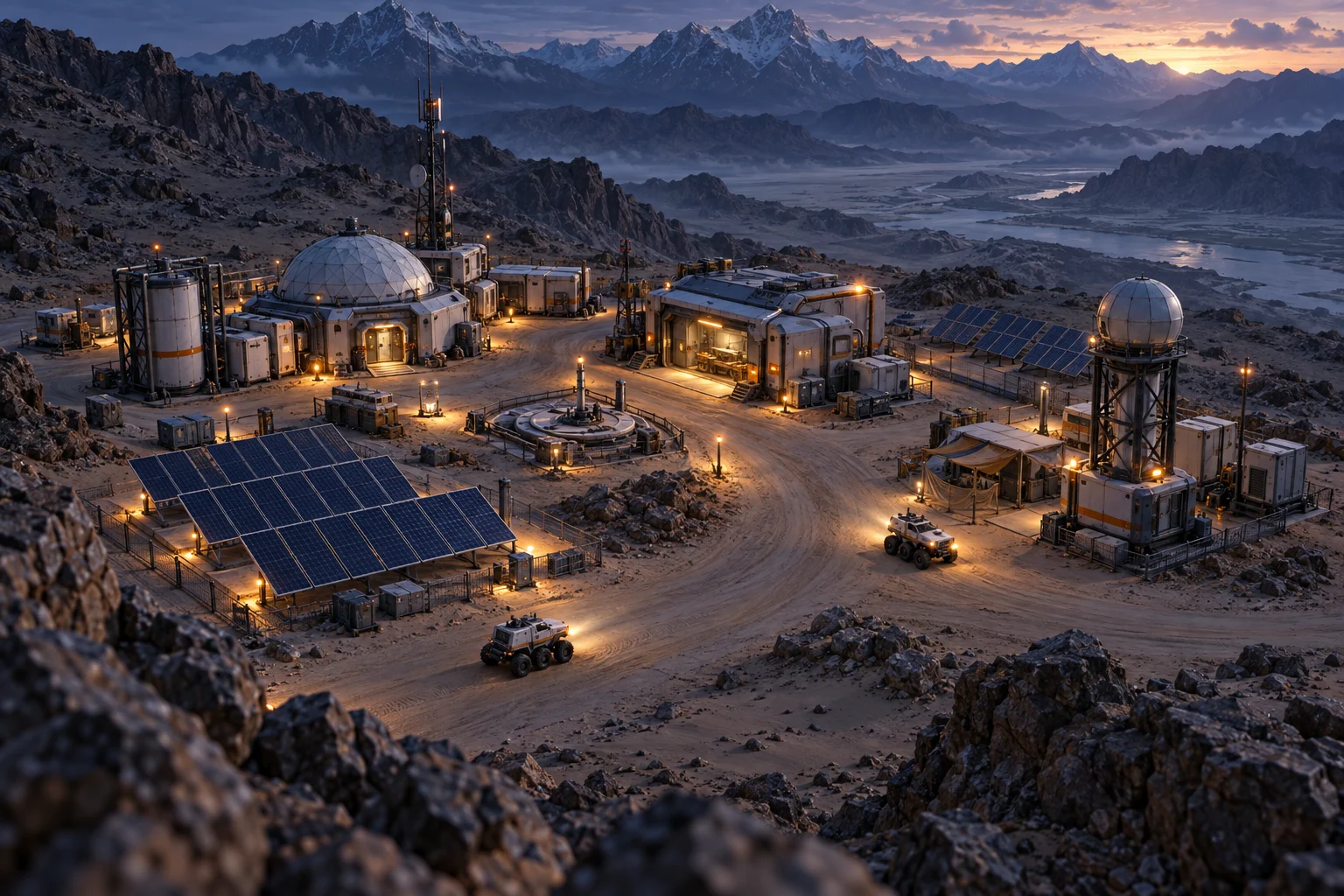
An RPG-oriented slice might explore a single quest, a conversation and a small traversable space. An RTS-oriented prototype might focus on selecting units, moving them and allocating a resource. Neither needs an enormous world to demonstrate strong design.
These are academy learning directions, not limitations of the engines. A technical review should determine whether an existing project stays in its engine or uses a carefully scoped transition.
Explore creative and technical rolesBEFORE YOUR FIRST SESSION
Know the journey.
Find your starting point.
Workload, equipment, team roles, assessment and the questions worth asking before you enroll—all in one student guide.
Read the student guideYOUR NEXT CHAPTER STARTS HERE
Don't just play worlds.
Create them.
Free registration of interest. No commitment.